How to Save Money on Long-Term Care Insurance

Often, the best way to handle the problem of long-term health care costs is to buy long-term care insurance. If you can afford the premiums and you’re insurable, this can save you a lot of money in the long run.

However, long-term care insurance can be expensive. If you’re thinking about purchasing a policy, here are some things to consider:

How much coverage do you really need? A good way to get started, and to avoid overpaying, is to calculate how much of a benefit you actually require.

For instance, the national average cost of a private room in a nursing home is about $250 a day, and the average monthly base rate in an assisted living facility is $3,550, according to MetLife’s 2012 survey of long-term care costs. These numbers can vary widely from location to location.

One easy way to calculate a daily benefit is to take the average cost of care where you live (or are likely to live when you’ll need care), and subtract from that your daily income. For instance, if nursing homes cost $300 a day in your area, and your income is $3,000 a month, or $100 a day, then your daily benefit should be about $200.

Check what period the policy covers. In general, the shortest period of coverage available is two years, but policies can be purchased for much longer periods or even for your lifetime. Of course, the longer the policy’s coverage period, the higher the premiums will be.

Most people don’t actually need lifetime coverage. Often, a good length of time is five years, because statistically it’s unusual for someone to need care for more than five years. In addition, Medicaid looks back five years for any asset transfers. If you purchase five years of long-term care coverage, you could transfer most or all of your assets to your children or to a trust, pay for your care with insurance over five years, and then qualify for Medicaid coverage.

Consider a smaller benefit. A policy that pays $200 a day for five years might still be expensive, especially if it includes an inflation rider. If you can’t afford such coverage, you could think of long-term care insurance as “avoid nursing home” insurance. Under this approach, you could purchase just enough insurance to pay for home care or assisted living care, which are usually not fully covered by Medicaid.

For example, if you purchased insurance with a daily benefit of $100, you would have about $6,000 a month to cover your living expenses plus home care or assisted living costs. The premium for such a policy would likely be much more affordable than one for a policy with a daily benefit of $200.

Buy when you’re younger. Long-term care insurance premiums rise as you age, so the younger you buy, the cheaper your premiums. Be careful, however, because insurance premiums can, and often do, increase considerably from your initial purchase price. Even if you have a policy that is “guaranteed renewable,” your premiums could still increase.

Limit coverage to one spouse. Often, a married couple will be able to afford coverage for only one spouse. This can be a reasonable option, particularly because the Medicaid rules provide some protection for the spouse of a nursing home resident.

If you have no specific reason to think that one spouse is more likely to require long-term care than the other, then looking at statistics alone, the wife should probably purchase the policy. In our society, women tend to live longer than men, and are much more likely to end up in a nursing home for a long period of time.

Of course, this amounts to playing the odds and is not a sure thing. On the other hand, some companies offer incentives for both spouses to purchase coverage, such as a premium discount for the second spouse.

Consider a ‘shared care’ policy. If both you and your spouse are purchasing long-term care insurance, a “shared care” policy might give you more coverage for less money.

With this kind of policy, you buy a pool of benefits that you can split between you and your spouse. For example, if you buy a five-year policy, you will have a total of 10 years between you and your spouse. If your spouse uses two years of the policy, you will still have eight years.

A shared care policy may cost more than separate policies with the same benefit period, but it will allow you to buy a shorter policy knowing that you will have a shared pool of benefits to work with.

Choose a longer waiting period. Most policies have a waiting period before coverage begins, typically 30 to 90 days. The longer you make this waiting period (which policies typically refer to as an “elimination period”), the cheaper your premiums. Keep in mind, however, that you will have to pay for your care out-of-pocket until the waiting period is over and the insurance begins its coverage.

Be careful with inflation protection. Inflation protection increases the value of your benefit to keep up with inflation, and is generally recommended. But you should give some thought to whether you want compound-interest increases or simple-interest increases. If you’re purchasing a long-term policy and you’re age 62 or younger, then you’ll most likely want compound inflation protection. But if you’re 63 or older, some experts believe that simple inflation increases may be enough, and you’ll save considerably on premium costs.

Many Estates Can Save Money by Filing Tax Returns — Even If They Don’t Have To

A federal estate tax return doesn’t have to be filed every time someone dies. In fact, most estates never have to file one. However, a provision in the new “fiscal cliff” tax law may make it very advantageous to file an estate tax return if the deceased person is survived by a spouse – even if a return is not legally required.

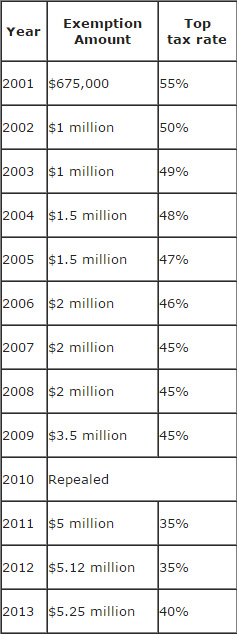
Here’s why: Generally, when a person dies, his or her estate can give an unlimited amount to a surviving spouse. After that, if the person’s bequests (plus large lifetime gifts) total more than a certain “exemption amount,” then an estate tax is due. For 2013, the exemption amount is $5.25 million.

Traditionally, the exemption amount applied separately to each spouse. So if a husband died first, his estate could use his exemption amount, and when his wife died later, she would get her own exemption amount.

But under a change in the law starting in 2011, if the first spouse to die doesn’t use all of his or her exemption amount, the difference can be passed along to the other spouse. (The 2011 law was temporary, but the new “fiscal cliff” law makes it permanent.)

So suppose a husband dies and doesn’t use any of his $5.25 million amount (because he leaves everything to his wife). When the wife dies, her exemption amount will be her own $5.25 million plus the $5.25 million that the husband didn’t use. So instead of being able to leave $5.25 million tax-free to her heirs, she can leave $10.5 million tax-free – a potential savings of millions of dollars.

However, this only works if the husband’s estate filed an estate tax return and elected to pass the exemption amount on to his wife. If the husband’s estate didn’t file a return (because it wasn’t legally required), then all the potential tax savings are lost.

This means that it’s almost always a good idea to file an estate tax return for anyone who dies and is survived by a spouse.

Even if it seems highly unlikely that a surviving spouse will be worth more than $5.25 million when he or she dies, it’s still a good idea to file a return, because Congress could always change the exemption amount. In fact, if not for the “fiscal cliff” law, the exemption amount this year would be only $1 million.

Roth 401(k) Plans Get a Big Boost in the New Tax Law

The new tax law that resolved the “fiscal cliff” issue in January allows employees with a 401(k) plan at work to roll over any or all of the assets in their current plan into a Roth 401(k) plan. This is a big change, and should at least be considered by anyone who is eligible.

In a traditional IRA or 401(k) plan, employees contribute pre-tax earnings to the plan. The assets grow tax-free until retirement age, at which point the employee can withdraw them and pay ordinary income tax on the withdrawals.

With a Roth IRA, though, employees contribute post-tax earnings to the account, but when they withdraw the assets years later, the withdrawals are tax-free.

The new Roth 401(k) plans follow the same idea – earnings are contributed post-tax, but withdrawals are tax-free.

Roth 401(k) plans were first allowed by Congress in 2006, but they were more limited, and rollovers of current 401(k) assets were severely restricted. At the time, not many employers bothered to create Roth 401(k) plans. But with the new law, it’s likely that many more employers will begin to offer Roth 401(k)s as a result of employee demand.

The law also allows rollovers to Roth 403(b) plans, Roth 457(b) plans, and Roth thrift saving plans.

The trick with a Roth rollover – whether from a traditional IRA or a traditional 401(k) or other plan – is that you have to pay income tax in the year of the rollover on the amount of assets you transfer.
Having to pay the income tax now is a drawback, of course, but if you have the assets to do so, a rollover can be very smart. For instance, if you anticipate being in a higher tax bracket when you retire, or if you believe that tax rates in general will go up, then you might want to pay the income tax now at today’s lower rates.

Also, if you plan to eventually convert your 401(k) to an IRA and leave it to your heirs, then a rollover might make sense because you’ll get the amount of the income tax out of your estate for estate tax purposes, and you’ll leave your heirs a better benefit because their withdrawals will be tax-free.

Keep in mind that rollovers are not “all or nothing.” You can roll over only a part of your 401(k) account each year, and pay taxes on just that amount.

Another benefit of Roth 401(k)s is that the contribution limits are generally much higher than for Roth IRAs.

You should note that if you roll over a traditional 401(k) into a Roth 401(k), you can’t “undo” the conversion the following year, as you can when you roll a traditional IRA into a Roth IRA. (The ability to undo the conversion is a benefit, because if the assets in your IRA incur significant losses after the conversion, you can simply undo it and then redo it the next year while paying less in taxes.)

Annual Gift Tax Exemption has been Increased to $14,000

The annual gift tax exemption has been increased to $14,000 in 2013, up from $13,000 last year. That’s due to an adjustment for inflation.

This means that you can give any person $14,000 this year without any gift tax liability at all. Making annual gifts of the exemption amount is one of the best and easiest forms of estate planning, because it transfers assets from one generation to the next without any tax liability whatsoever.

If you have multiple heirs, the amount you can give away tax-free multiplies quickly. For instance, if you have two children, and each child is married and has two children, you can give $14,000 to each child, spouse and grandchild. That’s eight recipients at $14,000 each, or a potential maximum gift of $112,000 a year.

Keep in mind that a spouse can also make gifts. If your spouse gave an additional $14,000 to each recipient, that would be $224,000.

If you’re thinking about making regular annual gifts, you might want to consider setting up trusts for the beneficiaries and making gifts to the trusts – especially if your grandchildren are young.

Making annual gifts to trusts is more complicated, and there are special techniques that usually must be followed in order to obtain the best tax treatment. However, there are many practical as well as tax benefits to making gifts by means of a trust, and doing so can further increase the value of your gifts.

How the New Federal Tax Law will affect your Estate Planning

In a big surprise to many people, when Congress passed a law to resolve the “fiscal cliff” in January, it retained the large ($5 million-plus) estate, gift, and generation-skipping transfer tax exemptions that had been available in 2011 and 2012. These taxes will now be 40% of amounts over this exemption.

Without this new law, the exemptions would have dropped to only $1 million at the start of 2013, with a tax rate of 55%.

The exemptions will now be $5 million in 2011 dollars, with adjustments for inflation each year. For 2013, they will be $5.25 million.

This is great news for people who want to transfer wealth to the next generation while avoiding taxes. It means that anyone who didn’t use the “window” in 2011 and 2012 to make large gifts without incurring gift tax has a reprieve, and can make those gifts this year.

That makes 2013 a great time to review your estate plan. While it’s possible to make large tax-deferred gifts right now, we don’t know how long this opportunity will continue, and it’s possible that Congress could change the rules again. Also, the Obama Administration has indicated that wants to restrict some other popular estate planning techniques, including grantor retained annuity trusts, valuation discounts, family limited partnerships, and dynasty trusts. So it might be wise to investigate these options now before they disappear.

How tax-free gifts work

The gift tax applies anytime you make a gift to someone other than a spouse or a charity. In general, you can give any person (or, in some circumstances, a trust) up to $14,000 a year without there being a gift tax. If you give someone more than $14,000 in a calendar year, then the tax applies to the excess.

However, you also have a “lifetime exemption.” Over the course of your lifetime, you can make gifts over the $14,000 annual threshold up to the amount of this exemption without paying tax.

The lifetime exemption isn’t necessarily a complete “freebie.” Any amount you use of your lifetime exemption is subtracted from your estate tax exemption, such that when you die, your estate taxes might be higher. But in general, the tax benefits of using the lifetime exemption far outweigh the disadvantages.

Since the lifetime exemption is $5.25 million for the rest of this year, you may be able to make gifts of up to $5.25 million this year without paying gift tax. Even if you already used up part of all of your lifetime exemption in the past, when the amount was smaller, you can now make very large additional gifts.

Many people can benefit from this situation by putting significant assets into a trust that will pay income to their children, and ultimately benefit their grandchildren.

Here are some of the benefits of such a trust:

  • Suppose you transfer an asset worth $1.5 million to a trust today, and by the time you die, that asset has increased in value to $2 million. The entire increase – $500,000 – will go to your heirs without being subject to estate tax.
  • Suppose the asset also generates annual income. For instance, over the course of the rest of your life, it might generate $300,000 in income. That entire $300,000 may also be able to go to your heirs without being subject to estate tax.
  • Suppose you set up the trust so that your children receive the income, and when they die, the trust assets go to your grandchildren. The entire trust, regardless of how much it has increased in value, will go to your grandchildren without any estate tax being due when your children pass away.
  • You will also have protected your children and grandchildren, because assets left in a trust for them generally can’t be taken away if your children or grandchildren incur debts, are sued in a lawsuit, get divorced, etc.

It’s a great idea to contribute assets that are temporarily reduced in value and that have the potential for significant appreciation. In the current environment, real estate might be a good example.

Remember, too, that the $5.25 million gift tax exemption is per person. So a married couple could contribute as much as $10.5 million.

Also, if you’re in a committed relationship with someone but you aren’t married to them, there may be significant tax benefits in using the $5.25 million exemption in order to share assets with the other person. (Remember that transfers between spouses aren’t generally subject to the gift tax, but transfers between unmarried couples are.)

Terms of Use

We invite our subscribers to enjoy all the features this site has to offer. But we must require that each subscriber abide by certain rules so that no one’s rights are stepped on. Failure to abide by these rules can result in immediate termination of access to this site, without refund or recourse.

Terms of Use

  1. Do not share your logon passwords and user names. Our system is designed to detect this immediately, and suspend any account where more than one person signs on using the same username and password.
  2. Do not reprint, republish, repost, or otherwise distribute or transmit content or images presented on this site. Downloading is easy, but just because you may be able to copy our content doesn’t mean you own it. Unauthorized use of or copying of our content, trademarks, and other proprietary material can subject you to civil or even criminal liability. Please don’t violate our copyright.
  3. No advertising, trading of goods or services, or other commercial use is allowed except in classified ad forums. No bulk e-mail, junk mail or spam, chain letters, or repeat postings of the same message is permitted anywhere on the forums.
  4. Please use your own name when posting to the discussion forums. Do not impersonate anyone else.
  5. Treat other subscribers with courtesy and respect when posting messages to the discussion groups. No unnecessary name calling or abuse toward any subscriber is allowed.
  6. Please avoid shouting (using all capital letters) in the discussion forums.
  7. Do not use vulgarity, obscenity, profanity, ethnic slurs, hate speech, or sexually explicit language, or harass, abuse, or threaten other subscribers in the discussion forums. Do not libel or defame others. This site strongly disapproves flaming.
  8. When you post content in the discussion forums, you permit this site to display and distribute the content, and to use it for advertising and promotion. You grant to this site the complete, perpetual, but non-exclusive right to use, reproduce, modify, adapt, translate, distribute, sub-license, etc. the content in whole or in part, throughout the world and universe, on a royalty-free basis.
    We do not try to edit or to monitor messages posted on the discussion forums, but we reserve the right to edit or remove objectionable postings. The person posting a message is solely responsible for it, not this site. Violators may be permanently banned from using the forums, or even have their subscriptions terminated.

Copyright and Trademark Law
All editorial content and graphics on this site are protected by U.S. copyright and international treaties and may not be copied or re-used without the express written permission of this site, which reserves all rights .

Disclaimer
Although many of the moderators and contributors to this site are attorneys, we are not your attorneys nor are we providing you with legal services. Rather, we are sharing our expertise to allow you to solve many of your trust and estate issues independently and effectively on your own. If at any time you wish to retain an attorney (from this site or elsewhere) you should make formal arrangements with that attorney directly. We hope that this site empowers you to find all the support and solutions you need to get your trust or estate back on track

Limitation of Liability
THIS SITE PROVIDES THE INFORMATION, SERVICES AND PRODUCTS ON THIS WEBSITE “AS IS” WITHOUT WARRANTIES OF ANY KIND. YOU ALSO AGREE THAT THIS SITE SHALL NOT BE RESPONSIBLE FOR ANY CONTENT FOUND ON THE THIS SITE FORUMS AND THAT YOUR USE OF THIS SITE FORUMS AND ANY DOWNLOADING OF MATERIALS FOUND ON OR THROUGHOUT THE THIS SITE FORUMS IS DONE AT YOUR OWN RISK AND THAT YOU WILL BE SOLELY RESPONSIBLE FOR ANY DAMAGES TO YOUR COMPUTER OR DATA THAT RESULTS. ALL EXPRESS WARRANTIES AND ALL IMPLIED WARRANTIES, INCLUDING WITHOUT LIMITATION WARRANTIES OF MERCHANTABILITY AND FITNESS FOR A PARTICULAR PURPOSE, AND NON-INFRINGEMENT OF PROPRIETARY RIGHTS ARE HEREBY DISCLAIMED TO THE FULL EXTENT PERMITTED BY LAW. THIS SITE DOES NOT WARRANT THAT THE USE OF PERFORMANCE OF THIS WEBSITE WILL BE TIMELY, UNINTERRUPTED OR FREE OF ERROR, OR THAT THIS WEBSITE OR ITS SERVER WILL BE FREE OF VIRUSES. IN NO EVENT SHALL THIS SITE, ITS OFFICERS, DIRECTORS, AGENTS AND EMPLOYEES BE LIABLE FOR ANY LOSS OR INJURY, DIRECT OR INDIRECT, INCIDENTAL, CONSEQUENTIAL, SPECIAL OR EXEMPLARY DAMAGES, OR ANY DAMAGES WHATSOEVER ARISING FROM THE USE OR PERFORMANCE OF THIS WEBSITE OR FROM ANY INFORMATION, SERVICES OR PRODUCTS PROVIDED THROUGH THIS WEBSITE, EVEN IF THIS SITE HAS BEEN ADVISED OF THE POSSIBILITY OF SUCH DAMAGES. IN THE EVENT THAT APPLICABLE LAW PREVENTS THE EXCLUSION OF LIABILITY FOR CERTAIN WARRANTIES, SUCH EXCLUSION DOES NOT APPLY TO YOU TO THE EXTENT LIMITED BY LAW.

The Three P’s of Communicating with your Trustee

1 – Be Polite:

No matter how frustrated you may be, you need to keep your composure and be polite to the Trustee.

Your tone should be calm and confident. Why? Because it is in your best interest.

If you are hostile to the trustee, they may view you as someone who is NOT capable of receiving trust distributions, of participating in investment discussions, or otherwise dealing with the trust.

Why would you want to contribute to that view? Instead, keep calm even when you have good reason to be upset.

2 – Be Professional:

Your trust is a major financial asset.

It holds assets, pays taxes and is watched over by a Trustee, an investment manager, an accountant, and various beneficiaries.

What does this mean? Your trust is a business matter.

Yes, your trust may have much emotional meaning to you as a beneficiary since it was established for your benefit by a family member. This is very legitimate and important.

To the trustee, however, your trust is dealt with as a serious business matter. He or she is responsible for carrying out the grantor’s wishes, for managing or overseeing the investments, for overseeing the tax preparation and payments and for keeping a balanced perspective for both income beneficiaries and remaindermen.

The more you begin viewing your trust as your trustee does – that is as a business entity, the more you align yourself with the trustee and the easier it becomes to communicate with them.

So in your communications be professional and treat the trust as a business matter not just a family or personal matter.

3 – Be to the Point:

Make your requests “short and sweet.”

It is perfectly acceptable to add a nice word or two in your letter such as “I hope this letter finds you well.”

It is not appropriate, however, to write about other family events or personal matters in the trust letter. This is a sure way to lose your reader – the Trustee.

How to be sure you make your point? You can use one of our many sample letters to simply state what you need.

If you write your own longer letter, make sure you pause then go back and shorten it for clarity and content.

After writing the letter ask yourself how you’d feel receiving that letter.

Does it remind you of a collection agency letter? (too hostile!)

Does it sound like you’re talking to your best friend or therapist? (too personal!)

Or does it simply sound like a reasonable request from a reasonable beneficiary?

Once you can say “yes, it sounds reasonable” you’re ready to send your letter!

ad11 (1)

How Do I Get a Hold of My Trustee?

How do I get a hold of my Trustee? Phone, fax, letter, email?

This article will explain how to get the FASTEST response from your Trustee on any question:

Your trust is a major financial asset and if you have an important question about it, you’ll need the fastest response you can get. What can YOU do to make sure that happens?

Simple … follow these steps:

E-mail is the first and fastest choice.

Why?

  1. You get your question to the trustee instantly.
  2. You can “cc” your other advisors or family members.
  3. You can go back to your email, noting the date and time it was sent, and re-forward it as a reminder if need be.
  4. You’ll have an email response by the trustee to refer to.
  5. No hunting down paper trails.
  6. You can mark your emails “return receipt requested” to make sure it was received and read by your Trustee.
  7. You can also mark your emails “urgent” with a red flag or exclamation point

But what about the Trustee?

The Trustee will benefit too Why?

  1. The trustee can easily forward your request to his or her assistant to pull together the file and draft a response.
  2. The trustee can also easily forward it to other advisors (for example, the trust investment manager) and get their input.
  3. The trustee can also keep a dated record of conversations with beneficiaries.

Remember, trustees are generally “procedure” oriented. This is a typical personality trait of good trustees. They are diligent and follow through. So it is in your best interest to make it easy for them to respond to your request.

If for any reason, you don’t have an email account, you can set one up for free at Google. Simply select the “gmail” tab and you can set one up in minutes.

If your trustee doesn’t have email, you may ask him or her to set up an email account using the same method.

If not, we recommend the second choice: faxing.

Faxing of course requires added steps. You would type your request on a word processor, as you would any other letter. You would then fax your request to the trustee and allow them to respond.

If you don’t have a home fax machine, we recommend using eFax which is a low cost fax service that allows you to send and receive all faxes through your email account.

Again, you will have a record in your email account and will not be “hunting down” that last letter to the trustee.

If faxing does not work for you or your trustee, you can always mail your request via U.S. postal service or express mail service. This requires more steps, expense and delays and we don’t recommend it unless there is no other choice.

Lastly, is the phone call. Simply put, please don’t phone the trustee until you’ve given them a chance to review your request.

What often happens when you call the trustee “cold” is that he or she is not prepared to take your call. They do not have your trust file in front of them because they are working on other things. You may launch into a long discussion of what brought about the request and the best the trustee can do is scribble down some notes. If you are dealing with a bank trustee, they will need a written request from you anyway, for internal compliance reasons. So please don’t waste time with phone calls unless they are of a “following up” nature.

So get your email account ready and write out your questions. More on how to do that in “The Three P’s of Communicating With Your Trustee”.

ad11 (1)

How To Get More Income From Your Trust

Is your trust paying you only minimal income each year?

2%?

Less?

There IS a solution. Read on …

It is the classic struggle. Income beneficiaries want more income during their lifetimes. They want trustees to invest in income producing bonds and stocks. Remaindermen, on the other hand, want the most trust value at the end of the day and want trustees to invest in high growth stocks.

In response to these tensions and also in response to huge appreciation in many trust investment portfolios, most states have passed “Total Return Trust” laws.

These laws allow a trustee to pay out a fixed percentage of the trust assets each year to the income beneficiary, typically 3-5%. The trustee may make this distribution first from income and then from principal. Depending on the size of the trust this can be a significant increase in cash flow to the income beneficiary, for example:

$1,000,000 x 2% = $20,000/yr

$1,000,000 x 4% = $40,000/yr

Simply multiply the size of your trust by these figures to see how much Total Return could help you:

So if your trust has a current market value of $8,000,000

$8,000,000 x 2% = $160,000

$8,000,000 x 4% – $320,000

The larger your trust the larger your payout could be!

So why would the trustee agree to this Total Return arrangement? Because it is a win-win-win all around. The trustee can invest the trust portfolio in a higher growth mode to ensure that the trust principal is not spent during the income beneficiaries lifetime.

Income beneficiaries are happy because they get more income.

Remaindermen are happy because they get more growth.

Trustees are happy because they are authorized by law to make these larger distributions and therefore generally protected from liability if questions arise later.

So how will you know if you are eligible for larger income distributions?

Read our “How To Request Larger Income Distributions Article” here.

ad11 (1)