How Life Insurance Affects Your Medicaid Eligibility

In order to qualify for Medicaid in most states, you can’t have more than $2,000 in “countable” assets. When calculating their total assets, many people overlook life insurance, which can count as an asset depending on the type of insurance and the value of the policy.

Life insurance policies are usually either “term” or “whole life.” Term policies don’t count as an asset – and won’t affect Medicaid eligibility – because they don’t have an accumulated cash value. On the other hand, whole-life policies usually have a cash value that the owner can access, so they may be counted as an asset.

Medicaid generally exempts “small” whole-life policies – those with a death benefit of $1,500 or less. But if a policy’s face value is more than $1,500, then the policy’s cash surrender value becomes a countable asset.

Example: A whole-life policy has a death benefit of $1,750 and a cash surrender value of $700. Because the death benefit is more than $1,500, the $700 surrender value counts toward the $2,000 asset limit.

If you have a life insurance policy that may disqualify you from Medicaid, you have several options, including:

  • Surrender the policy and spend down the cash value.
  • Transfer ownership of the policy to your spouse or to a special needs trust. If you transfer the policy to your spouse, the cash value will be counted among the assets that the spouse of a Medicaid recipient is allowed to keep.
  • Transfer ownership of the policy to a funeral home. The policy can then be treated as a pre-payment of funeral expenses, which doesn’t count as an asset.
  • Take out a loan on the cash value. This reduces the cash value and the death benefit, but keeps the policy in place.

Before taking any action, talk with your attorney to find out what is the best strategy for you.
IRS Increases Long-Term Care Insurance Deductions for 2014

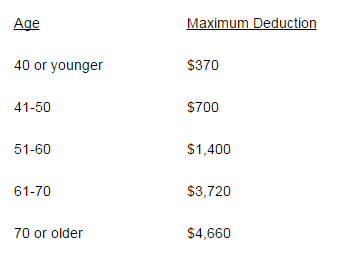
The amount you can deduct on your taxes as a result of buying long-term care insurance has been increased by the IRS for 2014.

If you itemize your deductions, you can generally claim a deduction if your premiums, together with your other unreimbursed medical expenses, amount to more than 10% of your adjusted gross income (or 7.5% if you’re 65 or older).

The maximum amount of the premiums you can deduct each year depends on your age at the end of the year:

table02

For policies issued in 1997 or later, the premiums are deductible so long as the policies meet certain requirements, such as that they offer “inflation protection” and “non-forfeiture protection.” (You don’t have to actually choose these options, but the policy has to offer them.)

For policies issued before 1997, the premiums are deductible if the policies were approved by the state insurance commissioner.

Here’s a New Idea for Buying Long-Term Care Insurance

Many middle-income people have too much money to qualify for Medicaid, but can’t afford a pricey long-term care insurance policy. In an effort to encourage more people to buy long-term care insurance, Congress created something called the “Qualified State Long-Term Care Partnership” program. In states that offer the program, you can buy special long-term care policies that allow you to protect your assets and still qualify for Medicaid when the long-term care policy runs out.

Here’s how it works: You buy a long-term care policy that is sold by a private company but that has been approved by the state under the program. The policy will cover at least some of your long-term care needs. If the policy runs out and you need to go on Medicaid, you can keep more of your assets than the $2,000 that Medicaid normally allows.

In most states, it’s a dollar-for-dollar benefit – for every dollar of coverage that the long-term care policy provides, you can keep a dollar in assets that normally would have to be spent down to qualify for Medicaid.

So if you buy a long-term care policy that provides $150,000 in benefits, you would be allowed to keep $152,000 in assets and still qualify for Medicaid. (Keep in mind that the exact details vary from state to state.)

Some states go even further. In New York, for instance, if you buy a policy that covers three years of nursing home care or six years of home care, then once you’ve exhausted the policy benefits, you can qualify for Medicaid with no limit whatsoever on the amount of your assets.

Keep in mind, though, that in order to obtain the Medicaid protection, you have to receive your long-term care in the same state where you bought the policy, or in another state that has a reciprocal agreement with the state where you bought the policy.

More information on this program (and on long-term care insurance in general) can be found at the National Clearinghouse for Long-Term Care Information at www.longtermcare.gov.

Surviving Spouses May Get Help with Reverse Mortgages

A federal court has thrown a life preserver to some surviving spouses who are facing foreclosure due to an “underwater” reverse mortgage.

In a traditional mortgage, you borrow money against your house and pay it back in monthly installments over time. With a reverse mortgage, you borrow money against your house, but you don’t have to pay it back until you die, sell the house, or move – which means you don’t owe anything as long as you stay in your home. In most cases, to qualify you must be at least 62 years old.

Sometimes, only one spouse has his or her name on a reverse mortgage. This might be because the other spouse was under age 62 when the mortgage was taken out, for example. In the past, some lenders have encouraged couples to put only the older spouse’s name on the mortgage because the couple could borrow more money that way.

The problem is that if only one spouse’s name is on the mortgage, and that spouse passes away, the entire mortgage comes due, and suddenly the other spouse has to pay it all off or lose the home. If the house is “underwater” (worth less than the balance due on the mortgage), the surviving spouse may be unable to refinance and repay the loan, and may face foreclosure and eviction.

Recently, the AARP filed a lawsuit on behalf of several spouses in this situation against the U.S. Department of Housing and Urban Development, which administers a reverse mortgage program. AARP claimed that HUD had a legal duty to protect surviving spouses from foreclosure.

In September, a federal court in Washington, D.C. agreed with AARP, and ordered HUD to find a way to shield surviving spouses from eviction.

It’s not clear yet how HUD will solve this problem. One possibility is that the agency may take over affected loans from the banks that hold them.

However, while the court ruling is very good news for spouses in this situation, seniors should still be very careful about taking out a new reverse mortgage with only one spouse’s name on it, at least until it becomes clear what rules HUD will create in response.

How Divorce and Remarriage Affect Social Security Benefits

Many people are aware that seniors are entitled to collect Social Security benefits that are calculated based on their spouse’s work record. What’s less well-known is that this benefit applies in many cases to divorced spouses. In fact, ex-spouses may even be entitled to survivors benefits in certain circumstances.

As a spouse, you have the option of (1) claiming a Social Security retirement benefit based on your own earnings record, or (2) collecting a spousal benefit equal to one-half of your spouse’s Social Security benefit. You are automatically entitled to whichever benefit is higher, and you can collect on your spouse’s record even if you never worked yourself.

A divorced spouse can collect benefits based on an ex-spouse’s work record, whether or not the ex-spouse has remarried and whether or not the ex-spouse’s new spouse is also collecting on the same work record.

But to receive this benefit, you must meet the following requirements:

  • Your ex-spouse is currently eligible for retirement benefits.
  • Your marriage lasted at least 10 years.
  • You are at least 62 years old.
  • You are currently unmarried.

If your ex-spouse has not yet applied for retirement benefits, but is eligible for them, you can receive benefits based on his or her work record as long as you have been divorced for at least two years.

If you have reached full retirement age and are eligible for both a spouse’s benefit and your own retirement benefit, you have a choice. One option is to receive only the spouse’s benefit for now, and delay receiving your own retirement benefit until a later date. The longer you delay taking your own benefit (up to age 70), the higher the monthly payment you will ultimately receive.

If you remarry, though, you cannot receive benefits based on your former spouse’s work record unless the new marriage ends (by death, divorce, or annulment).

Survivors benefits

If you’re divorced and your former spouse has passed away, you could be eligible for survivors benefits if the marriage lasted 10 years or more. Survivors benefits are equivalent to the deceased spouse’s full Social Security benefit amount.

However, if you remarry before the age of 60, you can’t collect survivors benefits (unless the later marriage ends for any reason). If you remarry after age 60, you can still receive survivors benefits based on your former spouse’s record.

It may be that your new spouse is also collecting Social Security benefits, and you would receive a higher amount based on the new spouse’s work record. If this is the case, you will receive the higher amount.

There is one circumstance in which you don’t have to meet the 10-year marriage rule – if you’re caring for a child who is under age 16 or disabled, and who is receiving benefits based on the work record of your former spouse.

How to Choose the Medicare Drug Plan That’s Right for You

Choosing the best drug plan under Medicare Part D isn’t always easy. Some people just pick the plan with the lowest premium, but that plan might not be the best value for you, depending on your needs.

The real cost of a plan depends not only on the premium, but also on the availability of the drugs you need, your additional out-of-pocket costs, and how convenient it is to obtain your medications.

Here are the key factors to consider (besides the premium) when deciding on a Part D plan:

The formulary. A plan’s “formulary” is the list of drugs it covers and will pay for.  Does the plan you’re considering include all the drugs you need, or anticipate needing? How much will they cost?

Keep in mind that a plan’s formulary can change from time to time, but typically, once you sign up for a plan for a year, the plan can’t drop your coverage of a drug you need until the end of the year.

If you switch to a plan that doesn’t cover a drug you’re currently taking, the plan might cover it anyway during a brief “transition” period. You might ask about this period. A one-month transition is fairly common (and might be all you need), but some plans have shorter or longer periods.

Also, if you’re prescribed a medically necessary drug that’s not in your plan’s formulary, the plan might in some cases make an exception. You might inquire as to your plan’s process for granting such an exception.

The deductible. Is the deductible the legal maximum ($325 in 2013), or something less? Some plans have no deductible at all.

Covered pharmacies. Will you be able to continue buying drugs at your customary pharmacy? Is that pharmacy a “preferred” provider, and if not, will you have to pay more to use it? If you’re living in a long-term care facility, is the facility’s pharmacy included in the plan’s network?

Expensive drugs. It’s worth looking into whether a plan will try to “steer” you toward using lower-cost drugs. For example, will it require that you try a cheaper medication before it will cover a more expensive one prescribed by your doctor? Also, are there different co-payments for generic and brand-name drugs?

Quantity limits. Is there a limit on the number of prescriptions you can receive in a month? Is there a limit on the number of pills available in a single prescription?

Mail-order. Are you allowed (or required) to use mail-order? Is there a price difference for mail-order purchases?

The plan sponsor. Is the sponsor a known, reliable entity?

Effect of state programs. How do the plan’s benefits coordinate with any state pharmaceutical assistance programs you might use?

If you’re currently enrolled in a Medicare drug plan, the window of opportunity to change plans runs from October 15 to December 7. If you’re newly eligible for Medicare, you can enroll in a prescription drug plan during the seven-month period that starts three months before the month you turn 65.

Have Life Insurance You Don’t Need? Consider Donating to Charity

If you have a whole-life or universal-life insurance policy that you don’t need, you might want to consider donating it to charity rather than cashing it in.

There are two ways to make such a donation, each of which has its advantages:

(1) Name the charity as the policy’s beneficiary. The key advantage to this method is that you retain control of the policy. Thus, you can always change your mind if you decide that your heirs need the money or if your feelings about the charity change. You’ll also get an estate tax deduction when the charity receives the money.

(2) Make the charity the owner of the policy. If you make the charity the owner of the policy, you can no longer change your mind. However, you’ll get an income tax deduction for the donation (which might be more valuable than the estate tax deduction now that the estate tax exemption is well over $5 million), and you’ll be recognized by the charity for having made a donation while you’re still alive.

Also, if you continue to pay the premiums on the policy after making the charity the owner, you may be able to take an income tax deduction for these payments as well.

Trust Could Force Beneficiaries to Arbitrate Rather than go to Court

Andrew Reitz set up a trust to benefit his sons, with an independent trustee. The trust document said that if there was a dispute between his sons and the trustee, it would be decided by a private arbitrator rather than a court.

When John Reitz, one of the sons, became unhappy with the trustee, he sued to have the trustee removed. The trustee argued that the suit should be thrown out of court, and decided by an arbitrator.

The dispute over who should decide the dispute went all the way to the Texas Supreme Court.

That court said the issue should go to an arbitrator. The judges ruled that (1) the trust should be handled according to Andrew’s clear intentions, and (2) it would be unfair to let John receive all the benefits of the trust, but ignore the one part of the trust he didn’t like.

If you set up a trust and you think there’s a chance that there could be disputes among the beneficiaries or between a beneficiary and the trustee, you might consider adding an arbitration requirement. Arbitration can be quicker and cheaper than a lawsuit, so money might be saved that could help the other beneficiaries. Also, arbitration is typically private while lawsuits are public, so arbitration could prevent an unhappy family’s internal disputes from being aired for all the world to see.

On the other hand, there can be disadvantages to arbitration as well. There are many procedural safeguards in a court proceeding that simply don’t exist when people go to arbitration.

Also, outside of Texas, it’s not always clear whether arbitration requirements in trusts are valid. A few courts have suggested that while arbitration requirements are valid in a contract, a trust isn’t a contract, and beneficiaries can’t be barred from going to court by a requirement in a document that they never signed.

Divorced Couples Need to Update Beneficiary Designations

One of the most important things people can do after a divorce is to update their beneficiary designations, and indicate who should get the assets in various accounts if they should unexpectedly pass away.

Most married people name their spouse as the beneficiary of their accounts, but in the stress following a divorce, they often forget to update these designations.

And even when people make an effort, they might not remember every account. Pensions, 401(k) plans, life insurance policies, brokerage accounts, bank accounts, and more may all have listed beneficiaries.

Remember that if you die, who gets the money in these accounts usually depends on who is the listed beneficiary – not who is named in your will. Even if your will says that “everything” will go to a new spouse or a child or other relative, the will doesn’t govern a separate account such as a 401(k) or an insurance policy.

Some states have tried to help divorced people by passing laws that say that a divorce automatically revokes these types of beneficiary designations. But even where that’s true, you need to name a new beneficiary, or the money might still go to someone who is not your choice.

Also, these laws don’t always work. For instance, Warren Hillman was a federal employee in Virginia who had low-cost group life insurance through a special program for federal workers. Warren married Judy in 1996 and named her as his life insurance beneficiary, but he divorced her two years later. In 2002, he married Jacqueline, but for whatever reason he never changed the beneficiary on his life insurance.

In 2008, Warren died. Both his wives claimed his $125,000 life insurance proceeds.

The case went all the way to the U.S. Supreme Court. The court said that, under Virginia law, a divorce revokes beneficiary designations such as on a life insurance policy. However, because the life insurance in this case was arranged under a federalprogram, and federal law trumps state law, the Virginia law didn’t apply – and therefore first-wife Judy, not second-wife Jacqueline, got the funds.

Of course, even people who haven’t been through a divorce should periodically review their beneficiary designations to make sure they’re all current, because these designations are an important part of a well-constructed estate plan.

Business Owners: Be Careful When Making Loans to a Company

If you own a business and you plan to loan money to the company, be sure to consult an attorney about the paperwork. Otherwise, the IRS could claim the money wasn’t a loan after all, and come after you for additional taxes.

Fred Blodgett found this out the hard way. Blodgett owned a small company (an S corporation) that sold architectural glass blocks. When the real estate downturn hit, he supported the company by transferring money to it from a family trust. He called this a loan. In subsequent years, the company paid him about $60,000, which he called a loan repayment.

Not so fast, the IRS said. According to the IRS, the “loan” wasn’t a loan at all, but a simple contribution of capital. And the “repayment” was actually just ordinary wages for the manager of the business. Therefore, the IRS claimed, the company owed more than $13,000 in employment taxes and penalties.

The U.S. Tax Court sided with the IRS. Although the money that Blodgett transferred to the business could have been a loan, the court said, Blodgett blew it because he didn’t create a paper trail showing that a bona fide loan was being made. There was no written loan agreement, no interest, no repayment schedule, and no collateral.

Although this case involved an S corporation and employment taxes, the IRS can also reclassify a “loan” in other ways, such as taxable compensation or taxable dividends.

If you’re thinking of making a loan to a business, be sure to treat it as a loan. Ideally, a written loan document should specify the repayment terms and schedule, interest, security, and subordination rights. Also, the loan shouldn’t be so large in relation to the company’s other operating capital that the IRS can argue that it’s commercially unreasonable.