Eight States are Easing their Estate Taxes in 2015

Eight states are reducing their estate tax burden in 2015, which is good news for anyone who lives or owns property in those states.

New York and Maryland are increasing their exemption amounts (the amount of assets an estate can have before any tax is due). During 2015, the New York limit will go from about $2 million to $3.125 million, and the Maryland limit will go from $1 million to $1.5 million. Both states plan to gradually raise their limits to the amount of the federal limit by 2019. (The federal limit was $5.34 million in 2014 and will be $5.43 million in 2015.)

Tennessee’s limit will be $5 million in 2015, and the tax will be repealed altogether in 2016.

Rhode Island’s limit will go from about $1 million to $1.5 million next year, and Minnesota’s will rise to $1.4 million, increasing gradually to $2 million in 2018.

Also, starting next year, the exemption amounts in Rhode Island, Washington, Hawaii and Delaware will be indexed each year for inflation.

New Danger for IRA Rollovers

There’s now a big danger if you’re rolling money over from one IRA into another IRA, as a result of a decision from the U.S. Tax Court.

Under federal law, you can only do one IRA-to-IRA rollover per year. If you try to roll over more than one IRA in a 365-day period, it’s considered a distribution, and you’ll be subject to significant taxes and penalties.

In the past, the IRS has told taxpayers that this means you can’t roll over the same IRA within a year. So if you rolled your Fidelity IRA over to Schwab, and you later wanted to roll the same IRA over to Vanguard, you had to wait at least 365 days.

But the Tax Court says this is wrong, and in fact you can’t roll over more than one IRA per year even if they’re different IRAs.

So if you had two IRAs at Fidelity, and you wanted to roll them both over to Schwab, you’d have to roll one over, and then wait a whole year to roll over the second one.

There’s an easy solution to this problem: Instead of rolling the funds over (having them made payable to you and then depositing them at the second institution), move them with a direct trustee-to-trustee transfer. As long as the funds move directly to the second institution, and you never touch them, it’s not considered a rollover.

But you have to be very careful and make sure that the formalities are followed and the first institution doesn’t actually send you any money. Otherwise, it could be a tax nightmare.

Inherited IRAs Aren’t Protected from Creditors

If you’re planning to leave an IRA or other retirement account to your heirs, you might want to consider creating a trust to hold the account. That’s the upshot of a recent ruling from the U.S. Supreme Court.

That’s because IRAs that are inherited from anyone other than a spouse are no longer protected from creditors in a bankruptcy.

Heidi Heffron-Clark and her husband Brandon filed for bankruptcy after their pizza shop failed in 2009. They owed their landlord $74,000, but didn’t have enough cash on hand to pay the debt.

Heidi did, however, have $293,000 in an IRA that she inherited from her mother.

In general, IRA funds are exempt from creditors in a bankruptcy. Congress created this rule in order to protect Americans’ retirement savings and to prevent elderly people from not having enough to live on.

But the Supreme Court made an exception, and said this rule doesn’t apply to inherited IRAs – at least if they were inherited from someone other than a spouse. Inherited IRAs are different, the court said, because the owner didn’t actually contribute any funds to them, and simply received them as a kind of windfall.

Therefore, Heidi’s IRA could be tapped to pay off the landlord.

As a result, if you’re planning to leave an IRA to your children or other heirs, and you want to protect the funds in case your heirs rack up business or personal debts or get sued in a lawsuit, you might want to leave the IRA to a trust instead.

A trust might not be absolutely foolproof, but it provides much better protection than simply leaving an IRA to someone directly.

Although the Supreme Court case involved an IRA, the same principle might well apply to other sorts of retirement plans such as 401(k) and 403(b) plans.

How to Help Your Trustee Make Good Decisions for Your Family

As Yogi Berra supposedly said, “It’s hard to make predictions, especially about the future.” Yet when you create a trust for your heirs, you have little choice but to make predictions about what their needs will be many years down the road.

Because circumstances change, it’s a good idea to make your trust flexible enough to accommodate the unexpected. If you tell your trustee what to do in too much detail, the trust might end up being useless or counter-productive if something unforeseen happens.

That’s why most trusts give trustees quite a lot of discretion. For instance, a trust might say that a trustee can make distributions to a spouse to help maintain his or her lifestyle, or to children for their health, education and support. But it’s up to the trustee to decide when and in what amounts these distributions should be made.

On the other hand, vague terms like these can sometimes be a problem. For instance, if you’re a trustee, how would you handle these dilemmas?

  • A surviving spouse wants more funds from the trust to help maintain her lifestyle, but this would deplete the trust assets, and when she dies, there will be very little left for the remainder beneficiary (a child of a previous marriage).
  • A college student wants you to pay his tuition bills, since they’re for “education.” But he also wants you to pay for an “enriching” trip to Europe to travel, take classes, and gain experiences related to his major.
  • A child quits her job because she wants to switch careers. She wants you to send her $5,000 a month as “support” until she finds a job in her new field.
  • Another child gets married to someone who develops cancer and requires expensive medical care. The child wants you to pay some of the spouse’s medical bills. However, the spouse isn’t one of the named beneficiaries of the trust.
  • Yet another child claims that distributions for “health” should include not only medical care, but also a gym membership, yoga classes, acupuncture, spa treatments, a hiking trip, and a three-day meditation retreat.

You can see the problem: The trustee has become a de facto parent, acting as arbiter of the beneficiaries’ needs and lifestyle choices. And the trustee must somehow do this while being “fair” to everyone and not spending so much that the trust runs out of assets.

One way to help with this situation is to give the trustee a lot of discretion in the trust document, but then write a separate “letter of intent” spelling out your hopes, dreams, goals, rules and limits regarding your family. This letter may not be legally binding, but it can be very useful to a trustee in making decisions.

For instance: If the trust will benefit one generation and then another generation, roughly how much money should be left for the second generation? Should the needs of one generation take precedence over the other? Are there circumstances where you’d make an exception – say, if someone develops an expensive illness?

If the trust will benefit several children, is it important to you that all the children ultimately receive a similar amount of the assets? Or can the trustee provide more to a child who has a greater need? And can distributions to children take into account the needs of their own family members?

Do you want your children to have relative comfort in their youth, and to take advantage of the experiences that comfort can provide? Or is it important to you that they earn their own way? And if one child is highly responsible and another is a spendthrift, is it okay for the trustee to treat them differently?

A “letter of intent” doesn’t have to be written in legalese, and you can revise it from time to time. Obviously, it can’t cover all possible issues – but it can at least give a trustee some clues as to what to do when he or she is asked to fund a new car or a backpacking trip across Italy.
Caregiver Options

Most seniors wish to “age in place” — that is, stay home with their creature comforts, routines and memories.  We encourage this as much as possible.  However, when Mom or Dad need extra help you may need to get them a home health aide, but where to look?  Here are some options:

  1. A personal referral from a friend or family member who recently used someone “great” for their loved one.  Perhaps their loved one went to a nursing home or passed away and now the home health aide is seeking new employment.
  2. A local home health agency that will do an assessment of your loved one and place one or more aides in the home until the right “match” is made.  These aides are typically supervised by a Registered Nurse at the agency.  Most agencies are licensed by the state and train their aides extensively.
  3. Hiring a senior caregiver on a website such as www.Care.com.  Experience and cost vary.  Family pays privately and self supervises.
  4. Au pair websites now have senior care sections where young people from abroad spend 1-2 years living with your senior.  Training and country of origin vary but the live-in option is important for some seniors.  Additionally, this is a cost effective option when broken down hourly.https://www.greataupair.com/Senior_Caregiver_Service/Find_Senior_Caregiver/Senior_Caregiver_Agency.htm

We do not endorse any one method of hiring a home health aide or any specific website listed here.  We encourage families to explore all options before there is an emergency with their loved one.  We also encourage you to get as much direct input by your loved one as to their preferred caregiver as possible.

Also, please talk to your accountant about payroll issues and other reporting requirements when hiring a private home health aide.

You Should Have Your Estate Plan Reviewed If…

Some people think that once they’ve written a will and implemented an estate plan, they can forget all about it. Of course, that’s not true; an estate plan must be reviewed periodically and updated, or it can become out-of-date and actually frustrate all your good intentions.

As a general rule, an estate plan should be reviewed at least every five years to make sure it still reflects your personal and financial situation, your wishes, and the current tax laws.

But sometimes it’s good to look at an estate plan more often. For instance, if your plan contains any provisions for saving taxes, and it hasn’t been reviewed since the enormous changes in the federal estate tax laws that occurred at the beginning of 2013, it would be a good idea to reconsider whether there are now much more advantageous ways of accomplishing your goals.

You should also have your estate plan reviewed whenever:

  • You get married or divorced
  • One of your children reaches adulthood
  • Your spouse passes away
  • You have a significant increase or decrease in your assets
  • You move to another state
  • A guardian, executor, or trustee is no longer able to serve
  • You want to change your beneficiaries or how your assets will be distributed
  • There’s any other major change in your life that affects your family or financial outlook.

Some Real Estate Agents are Specializing in Helping Seniors

Seniors who are buying or selling a house often have very different issues from younger buyers and sellers. They may be contemplating downsizing, moving to a more accessible home, searching for an active adult community, or looking for a way to age in place.

Because of this, some real estate agents have now begun specializing in helping people who are age 50 and older.

A “Seniors Real Estate Specialist,” or SRES, is an agent who has completed a series of courses conducted by the National Association of Realtors on how to help seniors and their families with real estate issues. They can help seniors look at all the options available, including making modifications to a current home, buying or renting a new home, and moving to an assisted living facility.

An SRES can help seniors who need assistance with de-cluttering and staging a house for sale. They can also help pinpoint a new house that meets the specific needs of seniors – for instance, one that has easy transportation access and limited stairs, that’s located in a senior-friendly neighborhood, or that would be easy for heirs to sell.

You can find out more at www.sres.org.

A Quick Look at Medicare, Medicaid, and Nursing Homes

Many people are surprised to discover that Medicare actually provides very limited coverage for nursing homes.

In theory, Medicare Part A covers up to 100 days of care in a skilled nursing facility for each spell of illness. However, this is true only if the nursing-home care follows at least a three-day admission to a hospital. Further, after 20 days, you must pay a copayment of $157 a day (although this may be covered by Medigap insurance).

In addition, the definition of “skilled nursing” and the other conditions for obtaining this coverage are quite stringent. As a result, very few nursing home residents actually receive the full 100 days of coverage. In fact, Medicare pays for less than a quarter of long-term care costs in the U.S.

The other program that covers nursing home care – and provides much broader coverage – is Medicaid. But unlike Medicare, not all seniors are eligible for Medicaid. It’s designed for people with limited income and assets, and to be eligible, you must meet strict financial guidelines.

As a result, many people have to spend down their assets or exhaust their long-term care insurance before they become eligible for Medicaid.

Unlike Medicare, which is federal, Medicaid is a joint state-federal program. This complicates matters, because the Medicaid eligibility rules differ from state to state, and they keep changing as different state governments continually tinker with them. (Many states have their own names for the program, such as “Medi-Cal” in California and “MassHealth” in Massachusetts.)

It’s possible to qualify for both Medicare and Medicaid, with Medicare paying part of a nursing home bill and Medicaid picking up the rest.

Because the Medicare and Medicaid rules are very complicated, and because it’s sometimes possible to qualify for Medicaid while still preserving some significant assets, it’s wise to consult an attorney whenever you’re thinking about how to pay for long-term care in a nursing facility.

IRS Increases Long-Term Care Insurance Deductions for 2015

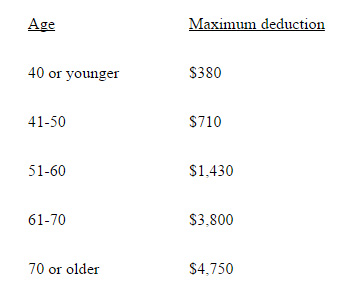
The amount you can deduct on your taxes as a result of buying long-term care insurance has been increased by the IRS for 2015.

If you itemize your deductions, you can generally claim a deduction if your premiums, together with your other unreimbursed medical expenses, amount to more than 10% of your adjusted gross income (or 7.5% if you’re 65 or older).

The maximum amount of the premiums you can deduct each year depends on your age at the end of the year:

table01

For policies issued in 1997 or later, the premiums are deductible so long as the policies meet certain requirements, such as that they offer “inflation protection” and “non-forfeiture protection.” (You don’t have to actually choose these options, but the policy has to offer them.)

For policies issued before 1997, the premiums are deductible if the policies were approved by the state insurance commissioner.

Should You Buy Long-Term Care Insurance? How To Decide

One of the most difficult financial decisions for middle-aged and older people is whether to purchase long-term care insurance.

On the one hand, LTCI premiums are generally high, they’re likely to increase in the future, and if you’re in your 50s or 60s, the need is probably decades away.

On the other hand, many people have been saved by having LTCI. It enables them to choose their own care setting, hire help without dipping into savings, and preserve an inheritance for their children.

Because it’s a difficult decision, it’s tempting just to put it off. But unless your circumstances are likely to change drastically in the future, the best time to decide about LTCI is now. Every year you wait, you’ll face higher premiums, and you’ll also run the risk that a health care event will make you ineligible for coverage.

A good first step is to decide if you’re a likely candidate for LTCI. You are if (1) you have enough income and assets that you can afford the premiums without dipping heavily into your savings or dramatically altering your standard of living, but (2) you don’t have so much wealth that you can easily afford the cost of long-term care.

Keep in mind, though, that many very affluent people still choose to buy LTCI, because they’d rather have the coverage than pay for care out-of-pocket and reduce their family’s inheritance.

If you’re a candidate for LTCI, then you should consider that it’s basically a gamble: You’ll come out ahead if you need the care, but you won’t if you don’t. So you might try a thought experiment: If you need care in your later years, how comfortable would you be using up your savings to pay for it? Would it make you feel worse if you paid years of premiums for insurance you didn’t use, or if you had to pay out-of-pocket for expenses that could have been covered by a long-term care policy?

If you decide to look into LTCI, you should be aware that it’s one of the most complicated insurance products available, with policies offering a wide variety of rates, benefit levels and conditions for payment. There’s also a proliferation of hybrid policies that merge LTCI with life insurance. It’s a good idea to talk to a specialist in this field who can guide you through all the options.